Calculator 1 of 4 · any currency · runs in your browser
How much do I need to retire?
Turn your monthly or yearly spending into a savings target in today's money. Subtract a state pension, a workplace or private pension and other income, choose whether the money should last for good or for a set number of years, and see which assumption moves the target most.
Your target nest egg
$1,000,000
in today's money
$1,448,298
in money of the year you retire (15 years, 2.5% inflation)
You plan to spend $40,000 a year, all from your portfolio. At a 4.0% withdrawal rate, the target is about 25 times that gap: $1,000,000 in today's money.
25 blocks equals target today
- Today's money $1,000,000
- Money of the year you retire $1,448,298
With a pension that does not rise with inflation, the set-number-of-years method gives a fairer target.
With your savings today
Next: see how long this would last →
Pension and benefit amounts are the figures you enter. Check your official statement or your pension provider; rules on indexation and start age differ by country and scheme.
Educational estimate only – not financial, tax or legal advice. Results depend on your inputs and the assumptions shown below, are not guaranteed, and may use figures that are out of date. Check the official sources yourself and consider a licensed professional before you decide. Full disclaimer
General information only. It does not take into account your objectives, financial situation or needs; consider whether it is appropriate for you and read the PDS and TMD before acquiring a financial product.
Which assumption matters most?
Each row changes one assumption and keeps the rest. The step sizes are examples, not predictions. Amounts are the target in today's money.
| Assumption | Lower | Higher |
|---|
How it works
The calculator uses one line of math:
Target nest egg = (annual spending − other income) ÷ withdrawal rate
At a 4% withdrawal rate, that means 25 times your yearly gap. For the inflated target, today's figure is multiplied by (1 + inflation)years, so it shows the same buying power in money of the year you retire.
Monthly amounts are multiplied by 12. With the set number of years method, the target is the amount that pays the yearly gap at the start of each year for that many years and then runs out, with the rest growing at the return after inflation:
Target = gap × (1 − (1 + real return)−years) ÷ real return × (1 + real return)
The real return is (1 + return) ÷ (1 + inflation) − 1. If it is negative, the target is more than the gap times the number of years. A pension that does not rise with inflation is counted at a lower real value each year, so the gap grows over time. Savings today are grown at the real return until you retire, without new contributions, and compared with the target.
Assumptions
- The withdrawal rate is an initial rate: you take that share in year one and then raise the amount with inflation each year, as in the studies below.
- The research behind the 4% rule looked at 30-year retirements using past US stock and bond returns. Longer retirements, other markets, and lower future returns may call for a lower rate. See the 4% rule explained.
- Fees, taxes, and one-off costs are not included. If you pay them out of your portfolio, add them to your spending.
- State pensions, government benefits and other income are assumed to keep pace with inflation (many state pensions do, not all). If yours does not, a lower figure is the more cautious input.
- A workplace or private pension is assumed to rise with inflation unless you untick the box. The amount you enter is read as the amount at the start of retirement, in today's money.
- The default return of 5% and inflation of 2.5% are the site's example assumptions, the same in every calculator, not forecasts. For reference, a 50/50 US stock and bond mix returned 7.8% a year over 1928–2025, with US inflation at 3.0%. Fees and taxes would lower the return. One steady return is used every year: the order of good and poor years is not modelled.
- The sensitivity steps (spending and income ±10%, return and inflation ±1 point, withdrawal rate ±0.5 point, years ±5) are examples, not predictions.
- Inflation is a single average rate until retirement. Real inflation varies year to year.
- This is a planning estimate, not a guarantee and not personal advice.
Sources
- Bengen, W. P. (1994). "Determining Withdrawal Rates Using Historical Data." Journal of Financial Planning, October 1994, pp. 171–180. (PDF, Financial Planning Association). Also available as a 2004 reprint. On p. 173 (Figure 1(b)): with 50% stocks and 50% intermediate-term Treasuries, a 4% first-year withdrawal raised with inflation "in no past case" exhausted the portfolio "before 33 years". Checked against the original on 2026-10-17.
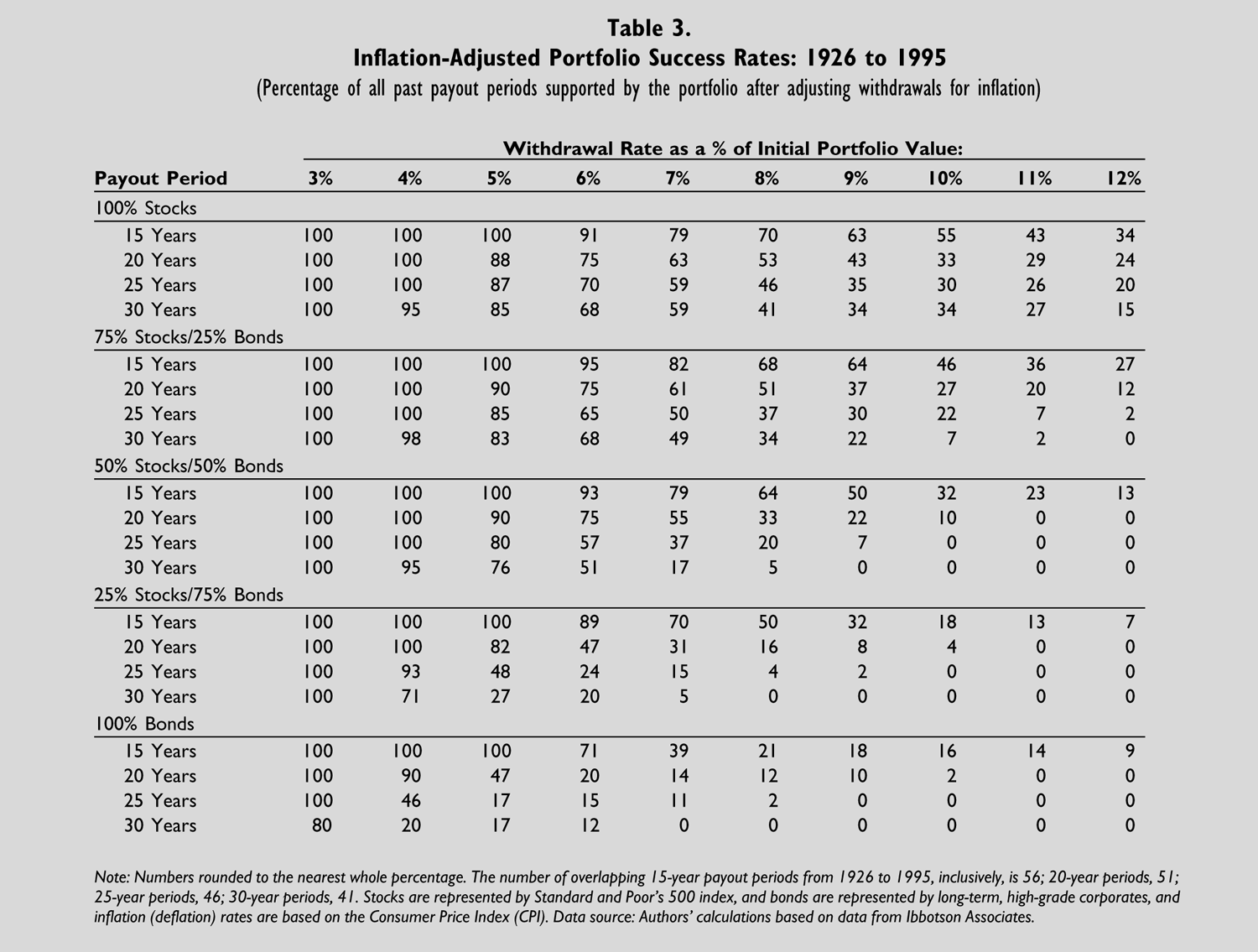
- Cooley, P. L., Hubbard, C. M. & Walz, D. T. (1998). "Retirement Savings: Choosing a Withdrawal Rate That Is Sustainable." AAII Journal, February 1998 (the "Trinity study"). (PDF). Table 3 ("Inflation-Adjusted Portfolio Success Rates: 1926 to 1995") shows that a 4% inflation-adjusted withdrawal from a 50% stocks / 50% bonds portfolio lasted 30 years in 95% of the 41 overlapping 30-year periods tested (1926–1995). At 6%, that fell to 51%. Stocks = S&P 500, bonds = long-term high-grade corporate bonds, inflation = CPI. Checked against Table 3 on 2026-10-17.
- Damodaran, A. "Historical Returns on Stocks, Bonds and Bills: 1928–2025." NYU Stern School of Business, data file histretSP.xls (updated January 2026). (data file, sheet "Returns by year"). Yearly total returns of the S&P 500 (with dividends) and 10-year US Treasury bonds, and US CPI inflation, 1928–2025. The compounded average of a 50/50 mix rebalanced each year was 7.8% a year before inflation; we show it as a reference next to the return field, not as the default. Downloaded and checked against the sheet's own averages on 2026-10-22.
Last reviewed: 2026-10-17. See our methodology and disclaimer.
Questions to ask a licensed adviser
- What will my state pension or government benefit be, from what age, and does it rise with inflation?
- Does my workplace or private pension rise with inflation, and what happens to it if I die or stop work early?
- Is my spending estimate realistic, including healthcare and one-off costs?
- How many years should I plan for, and why?
- Which return and inflation assumptions are reasonable for my situation and country?
- How do taxes change the amount I need to save?
- If there is a shortfall, which levers matter most for me: saving more, working longer, spending less or adjusting how I invest?
- How are you paid, and are you required to act in my best interest?
FAQ
What is the 4% rule?
The 4% rule is a rule of thumb from US research. It describes one way to withdraw: take 4% of the portfolio in the first year of retirement, then raise that amount with inflation each year. William Bengen (1994) tested this with US returns since 1926 for a portfolio of 50% stocks and 50% intermediate-term Treasuries; in no past case did it exhaust the portfolio in less than 33 years (Bengen, Journal of Financial Planning, October 1994, p. 173). Dividing your yearly spending by 4% is the same as multiplying it by 25.
Is 4% safe for me?
Nobody can promise that. The research is based on past US market returns; future returns, other countries, fees, taxes and retirements longer than 30 years are all outside what it tested, and each can make a lower rate the more cautious choice. That is why this calculator lets you test anything from 2.5% to 6%. It is an educational estimate, not personal advice.
Why does a lower withdrawal rate need a bigger nest egg?
The target is your yearly spending gap divided by the withdrawal rate. At 4% the target is 25 times the gap; at 3% it is about 33 times; at 5% it is 20 times. A lower rate is more cautious, so the same spending takes a bigger nest egg.
Should I include my state pension or Social Security?
You can, if you expect to receive it. Enter the yearly amount in today's money under "Other yearly income in retirement". The calculator subtracts it from your spending, so the portfolio only has to cover the gap. Your own figure is on your official statement, for example from SSA in the US or the State Pension forecast on gov.uk in the UK.
Which currency should I use?
Any currency you think in. The math is the same in every currency, so the calculator does no conversion: pick the currency you will spend in retirement and enter all amounts in it.
What does the inflated target mean?
Prices usually rise. If you retire in, say, 15 years, the same lifestyle would cost more in money of that year. The inflated target shows today's target grown by your expected inflation rate, so you can compare it with projected account balances.
Can I enter monthly amounts?
The calculator uses yearly amounts only. If you think in months, multiply your monthly spending and income by 12 before entering them.
Does this calculator store my data?
No. Everything is computed in your browser. What you type is not sent or stored, not even in your browser's local storage.
Get the numbers behind this tool by email
Your results stay in your browser.
A short weekly email: 1 number, 1 tool, 1 lesson, plus an update when official retirement numbers change. Education only, no products.
Sign-up happens on the Retirement Builders newsletter page, hosted by beehiiv. You enter your email address there; this site does not collect it, and nothing from the calculators is passed on.